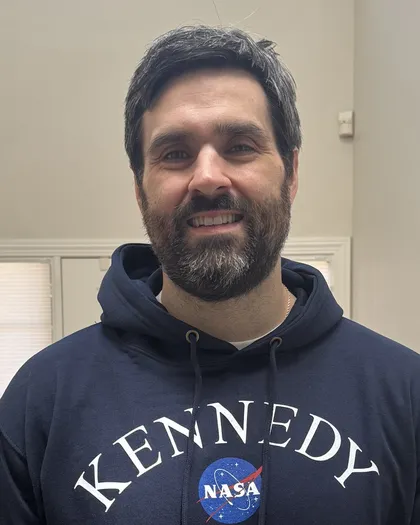
An engineer who teaches.
I'm Jack. I have a PhD in chemical engineering from Rensselaer Polytechnic Institute, I'm a licensed Professional Engineer in Oregon, and I have spent fifteen years actually using this material: in research, then at Intel and Lam Research, then in data science.
I also taught it. Six years as a teaching and research assistant at RPI, and in 2019 I was given the Phillip A. Groll Teaching Assistant Award. Knowing a subject and being able to explain it are genuinely different skills, and I have been assessed on both.
Credentials
- DoctoratePhD, Chemical & Biological Engineering, RPI
- LicenseProfessional Engineer, State of Oregon
- TeachingGroll Teaching Assistant Award, RPI 2019
- Research400+ scholarly citations
Why "Intuitive Engineer"
Intuition in a technical subject is not a gift that some students have and others do not. It is what you get when your mental model of the material is accurate enough to reason from.
Someone with that model can rebuild a formula they have forgotten, recognize an answer that cannot be physically right before they circle it, and handle a problem worded in a way they have never seen before. Someone running on memorized procedures can do none of those things, and it shows the moment a question is unfamiliar.
Building the model is slower at the start. It is also the only part that still works six months later, in the next course that assumes you understood this one.
Where I have used this
The subjects I tutor are not a list I assembled. They are the coursework behind a PhD in chemical engineering and the work I have done since.
- Semiconductor
- Etch process engineer at Intel, then Lam Research, owning production processes. A plasma etch chamber is reaction kinetics, mass transfer, and process control running at the same time, and it does not care whether the textbook version worked out cleanly.
- Research
- Six years at RPI modeling polymerization kinetics, transport phenomena, and Monte Carlo simulations in MATLAB and COMSOL. I did not study transport phenomena so that I could tutor it. I spent six years doing it.
- Data science
- Built Bayesian models and data pipelines in Python and SQL as a founding data scientist. This is where the computing and machine learning tutoring comes from.
How sessions work
- Format One-on-one, online
- Length 60 minutes
- Tools Video call plus a shared whiteboard
- First step A free 15-minute intro call